Commercial vs Residential Property Maintenance: A Practical Comparison for NSW
How commercial and residential strata building maintenance differs in NSW: compliance standards, inspection frequencies, cost structures, and NCC building classifications explained.
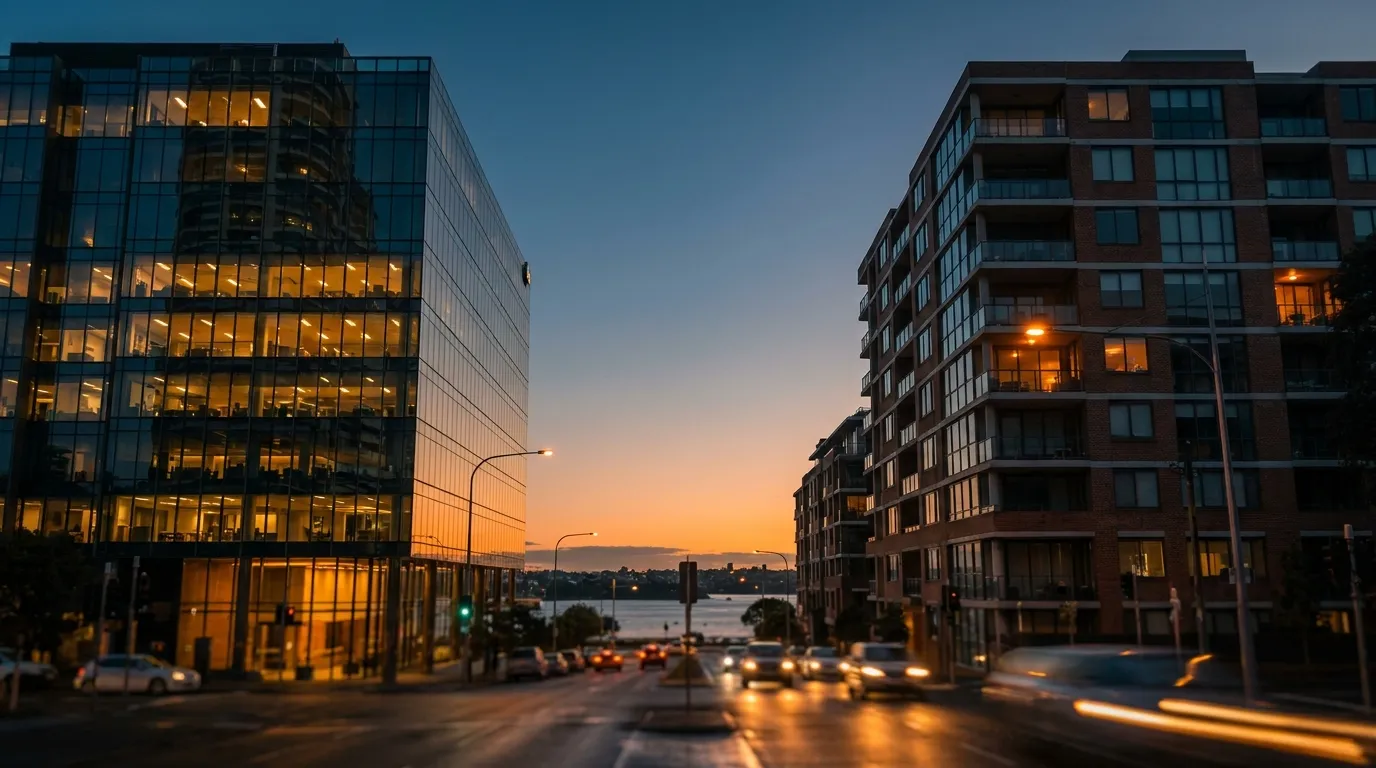
A residential property manager and a commercial facilities manager may both use the word "maintenance" for their daily work, but the maintenance programs they run operate under different compliance frameworks, different cost structures, and different asset profiles. Understanding those differences is relevant for any property professional who manages mixed portfolios, is considering commercial strata management, or simply wants to understand why the same type of repair costs a different amount in a commercial building. This article compares the two across the dimensions that matter in practice.
What Is Residential vs Commercial Strata?
Residential strata (Class 2 under the NCC 2025) refers to buildings containing two or more sole-occupancy units where people reside. In NSW, a typical residential strata building contains 6-100 lots, has a committee of lot owners, and is managed by a strata manager or self-managed by the OC. Lot owners are typically individuals or small investors. The building use is exclusively or predominantly residential.
Commercial strata (Class 5, 6, 7, or 8 under the NCC 2025) covers a range of building uses:
- Class 5: Office buildings used for professional or commercial purposes
- Class 6: Shop or other retail buildings used for the sale of goods or services to the public
- Class 7: Buildings for carparking (7a) or storage/wholesale display (7b)
- Class 8: Buildings used for production, assembly, laboratory or repair operations (light industrial)
Commercial strata buildings often have fewer lots than residential buildings, but the lots are larger and the lot owners are typically businesses or professional investors. The OC structure is the same under the Strata Schemes Management Act 2015, but the practical dynamics differ significantly.
Side-by-Side Comparison
| Dimension | Residential (Class 2) | Commercial (Class 5/6/7/8) |
|---|---|---|
| NCC building class | Class 2 | Class 5, 6, 7, or 8 |
| Typical lot count | 6-100 lots | 3-30 lots (varies widely) |
| Lot owner profile | Individuals, small investors | Businesses, professional investors, funds |
| Common property profile | Lobby, corridors, car park, pool, gardens | Lobby, car park, lifts, plant rooms, mechanical |
| Fire safety requirements | Residential sprinkler systems (buildings >25m), smoke detectors, fire doors | Commercial sprinkler systems, full FIP, smoke control systems, fire compartmentation |
| Mechanical plant | Basic - hot water, exhaust fans, pool pump | Complex - HVAC, BMS, cooling towers, mechanical ventilation |
| Lift requirements | Standard residential lifts (AS 1735) | Higher-duty commercial lifts, more stringent service intervals |
| Essential Safety Measures | Defined by occupation certificate, annually updated | More extensive schedule, higher inspection frequency |
| Access equipment | Abseiling, scaffold for periodic works | BMU (Building Maintenance Unit), permanent swing stage systems more common |
| Inspection frequency (fire systems) | Annual AS 1851 service | Quarterly or more frequent inspections for complex systems |
| OC levy structure | Residential administrative + capital works | Commercial administrative + capital works (often higher per lot) |
| 10-year capital works plan | Required | Required |
| Defect warranty period | DBP Act 10-year warranty (Class 2) | Varies - DBP Act does not apply to all commercial classes |
| After-hours maintenance | Primarily residents | 24/7 for critical building services in some commercial buildings |
| Lease maintenance obligations | RTA 2010 governs residential tenancy | Commercial Tenancy Act and individual lease terms govern |
NCC Classification and Compliance Implications
The NCC 2025 (National Construction Code) is the framework through which building classification determines the construction standard, fire safety requirements, and performance criteria that apply. These requirements flow through to the ongoing maintenance obligations via the Essential Safety Measures (ESM) schedule - the building-specific compliance document produced at occupation certification.
Class 2 Residential Compliance Focus
For a typical 10-storey residential strata building in Sydney:
- Fire system: Sprinklers required for buildings above 25m effective height (NCC 2025 Specification C2.3), annual service required under AS 1851
- Smoke detectors: Required in all sole-occupancy units, interlinked in newer buildings
- Fire doors: All exit stairwells and plant rooms, annual inspection
- Emergency and exit lighting: AS 2293 compliance, monthly test required
- Balustrades: 1m minimum height, structural loading requirements per NCC 2025
- Lift: Annual inspection under AS 1735, maintenance contract required
Class 5 Commercial Compliance Focus
For a typical 8-storey commercial office building in Sydney:
- Fire system: More complex - often includes both sprinklers and a full addressable fire indicator panel (FIP), with zone monitoring, multiple suppression systems in plant rooms
- Smoke control: Mechanical smoke exhaust systems in commercial buildings above a threshold, requiring separate annual commissioning and testing
- Emergency warning and intercommunication system (EWIS): Required in buildings above threshold, more complex than residential system
- Access control: Commercial buildings often have monitored access systems with specific maintenance requirements
- HVAC maintenance: Commercial buildings require HVAC inspection and filter replacement on quarterly or more frequent schedules
- Cooling towers: Buildings with cooling towers must comply with the Public Health (Legionella) Regulation 2018 (NSW) - mandatory risk management plans, monthly water sampling, quarterly inspection
This is not exhaustive - the specific ESM schedule for each building governs its unique compliance obligations. The point is that commercial buildings consistently carry a higher volume of compliance-critical maintenance items with higher inspection frequencies.
Inspection Frequencies Compared
The table below compares typical inspection frequencies for equivalent elements across residential and commercial buildings. "Typical" means consistent with market practice and the relevant Australian Standard - specific buildings may have higher requirements based on their ESM schedule.
| Element | Residential (Class 2) - Typical Frequency | Commercial (Class 5) - Typical Frequency |
|---|---|---|
| Fire hose reels | Annual service (AS 1851) | 6-monthly service (AS 1851) |
| Sprinkler system | Annual full service (AS 1851) | 6-monthly service + quarterly checks (AS 1851) |
| Emergency lighting | Monthly test (AS 2293) | Monthly test (AS 2293) - same |
| Exit signs | Monthly visual, annual test | Monthly visual, annual test - same |
| Lift | Annual inspection (AS 1735) | Typically more frequent (3-6 monthly) for high-use commercial lifts |
| HVAC filters | Varies - often 6-12 months | Quarterly to 6-monthly in commercial use |
| Cooling towers | N/A (residential) | Monthly water sampling, quarterly inspection (Public Health Regulation) |
| Electrical switchboard | Annual testing (AS 3000) | 6-monthly or more frequent for high-load commercial boards |
| Facade inspection | Annual to 2-yearly | Annual, with engineering inspection every 3-5 years for high-rise |
| Hydraulic testing | As required | More frequent for commercial hydraulic systems |
| BMS (building management system) | N/A | Annual recalibration minimum |
Cost Structure Differences
Commercial buildings cost more to maintain per unit of building area, and for good reasons: the systems are more complex, the inspection frequencies are higher, and the trade rates for specialist commercial systems are higher than for residential equivalents.
| Cost Category | Residential Strata | Commercial Strata | Variance |
|---|---|---|---|
| Fire system annual service | $1,500-$5,000 (typical residential) | $5,000-$25,000+ (commercial) | 3-5x |
| Lift maintenance contract | $3,000-$6,000/lift/year | $8,000-$15,000/lift/year (commercial-grade) | 2-3x |
| HVAC maintenance | $500-$2,000/year | $5,000-$30,000+/year (commercial plant) | 5-15x |
| Facade inspection | $1,500-$3,000 (lower-rise) | $3,000-$8,000+ (commercial, often involves engineering) | 2-3x |
| Cleaning (common areas) | $300-$800/week | $500-$2,000+/week (commercial lobby standards) | 1.5-2.5x |
| Access equipment (periodic) | Abseiling at $500-$1,500/day | BMU operation at $1,500-$4,000/day | 2-3x |
Strata Management and Governance Differences
While the legal framework is the same (Strata Schemes Management Act 2015), the governance dynamics differ.
Residential OCs tend to have:
- More lot owners, more diverse interests
- Higher emotional investment in common property decisions
- Greater friction around special levies and capital works
- More NCAT disputes between owners and the OC
- Strata manager role often includes significant owner communication
Commercial OCs tend to have:
- Fewer, more sophisticated lot owners
- More commercial decision-making frameworks
- Higher delegated authority to the committee
- More focus on NABERS ratings, sustainability, and tenant amenity
- Facilities management often sits separately from strata management
The commercial strata manager's role is closer to a facilities manager in some respects. The maintenance decisions are more technical, the contractors more specialised, and the cost base larger. A strata manager comfortable with residential portfolio management may find commercial buildings require a different skill base.
Structural Rectification and Defects
The obligations and options differ between residential and commercial when structural defects emerge.
For Class 2 residential buildings, the Design and Building Practitioners Act 2020 provides a 10-year statutory warranty for major defects. Buildings constructed after 11 June 2020 benefit from this framework - defects can be pursued against the developer, builder, or design practitioner regardless of contractual privity. The strata building bond scheme provides additional protection for the first two years.
For commercial buildings, the DBP Act warranty applies selectively and not uniformly to all commercial classes. Commercial parties generally rely on common law warranty and contract rights, which require a direct contractual relationship. This distinction means commercial OCs may have a weaker position against developers when structural or waterproofing defects emerge.
For structural concrete defects - which appear in both commercial and residential buildings from the same construction era - the diagnosis and rectification process is the same regardless of building class. See What Is Concrete Cancer: Sydney Guide for the detailed diagnostic framework.
Which Buildings Does Superb Maintenance Serve?
Our project portfolio across 860+ jobs includes both residential strata and commercial buildings. The inner Sydney commercial corridor - Pyrmont, Surry Hills, Zetland, the CBD fringe - contains a mix of residential apartments, commercial offices, and mixed-use buildings where the same building may include both Class 2 and Class 5 components.
Mixed-use buildings require a maintenance contractor who understands both compliance frameworks. A residential remedial contractor unfamiliar with commercial fire system requirements may complete a rectification job that creates a compliance issue with the building's ESM schedule. Multi-trade capability and an understanding of the NCC classification system are prerequisites for mixed-use work.
For maintenance across both residential and commercial strata portfolios, see our General Maintenance Services and Remedial Works Services.
See also:
- Maintenance Schedule Template for Property Managers
- Quarterly Inspection Checklist for Strata Buildings
- Building Defect Report Sydney Guide
- 2026 Sydney Building Remedial Cost Index
- All Real Estate Maintenance Articles
External references:
- Standards Australia - NCC and Building Standards
- NSW Government Strata Living
- LookUpStrata - Commercial Strata Resources
The Bottom Line
Commercial and residential strata buildings share a legal framework but operate under materially different compliance obligations, cost structures, and management demands. The NCC building classification tells you the construction standard. The Essential Safety Measures schedule tells you the ongoing maintenance obligations. The difference in cost is real and predictable - commercial buildings cost more to maintain because they contain more complex, higher-use systems with higher-frequency compliance requirements.
Property managers transitioning to commercial portfolios, or strata managers taking on mixed-use buildings, should map the ESM schedule against their maintenance program before assuming residential practice is sufficient. The gap between the two frameworks is large enough to create compliance exposure if it is not accounted for from the start.
Frequently asked questions
What is the main difference between a Class 2 and Class 5 building under the NCC?
Do commercial strata buildings have an owners corporation in NSW?
Are commercial building maintenance costs higher than residential?
Does the 10-year capital works plan requirement apply to commercial strata?
Who is responsible for maintaining a commercial tenant's fit-out?
Continue reading
The Maintenance Schedule Template Every Sydney Property Manager Should Use
A practical annual maintenance schedule for Sydney property managers: seasonal tasks, quarterly inspections, monthly high-risk checks, and weekly common-area routines.
75-Point Quarterly Inspection Checklist for Strata Buildings
A complete 75-point quarterly inspection checklist for NSW strata buildings: common areas, exterior, services, and safety with defect identification guidance.
Service Level Agreements for Strata Maintenance Contractors: What Every SLA Must Specify
What an SLA with a strata maintenance contractor must include: response tiers, trade availability, make-safe scope, KPI reporting, and cost structure. Sydney context.